Make sense of a bill or a confusing letter
Upload a bill or letter, get it explained in plain words, check every number against the paper, and call the number on your own bill.
Step 5 of 5 in Everyday ChatGPT, step by step (Path 04)
Heads up: these screenshots use the ChatGPT desktop app. This works on the free plan. Free accounts get about 3 file uploads a day, which is plenty for one bill.
Some mail makes your eyes glaze over. An insurance statement full of codes. A letter from the power company that takes two pages to say your payment is going up. Today ChatGPT reads it with you and explains it in plain words. It explains. You decide. And you always check the numbers against the paper.
Before you start
Heads up: these screenshots use the ChatGPT desktop app. This works on the free plan. Free accounts get about 3 file uploads a day, which is plenty for one bill. If you run out, copy the words and paste them in instead.
We practice with two made-up documents marked SAMPLE: a Bluestone Health "Explanation of Benefits" and a Cedar Valley Power letter. When you try this with your own mail later, cover your member ID, account number and Social Security number first. A sticky note before you take the picture works fine.
Screenshots are from November 1, 2026, with my chat list blurred. ChatGPT moves things around, so yours may not match.
You can click the microphone and ask your questions out loud, like in Lesson 31.
1. Start a temporary chat and add the paper
Click File, then New Temporary Chat, or press Ctrl+Shift+N on Windows. On a Mac, the File menu is at the very top of the screen. Click +, then Add photos & files, and pick the PDF or a photo of the letter. Then type your question.
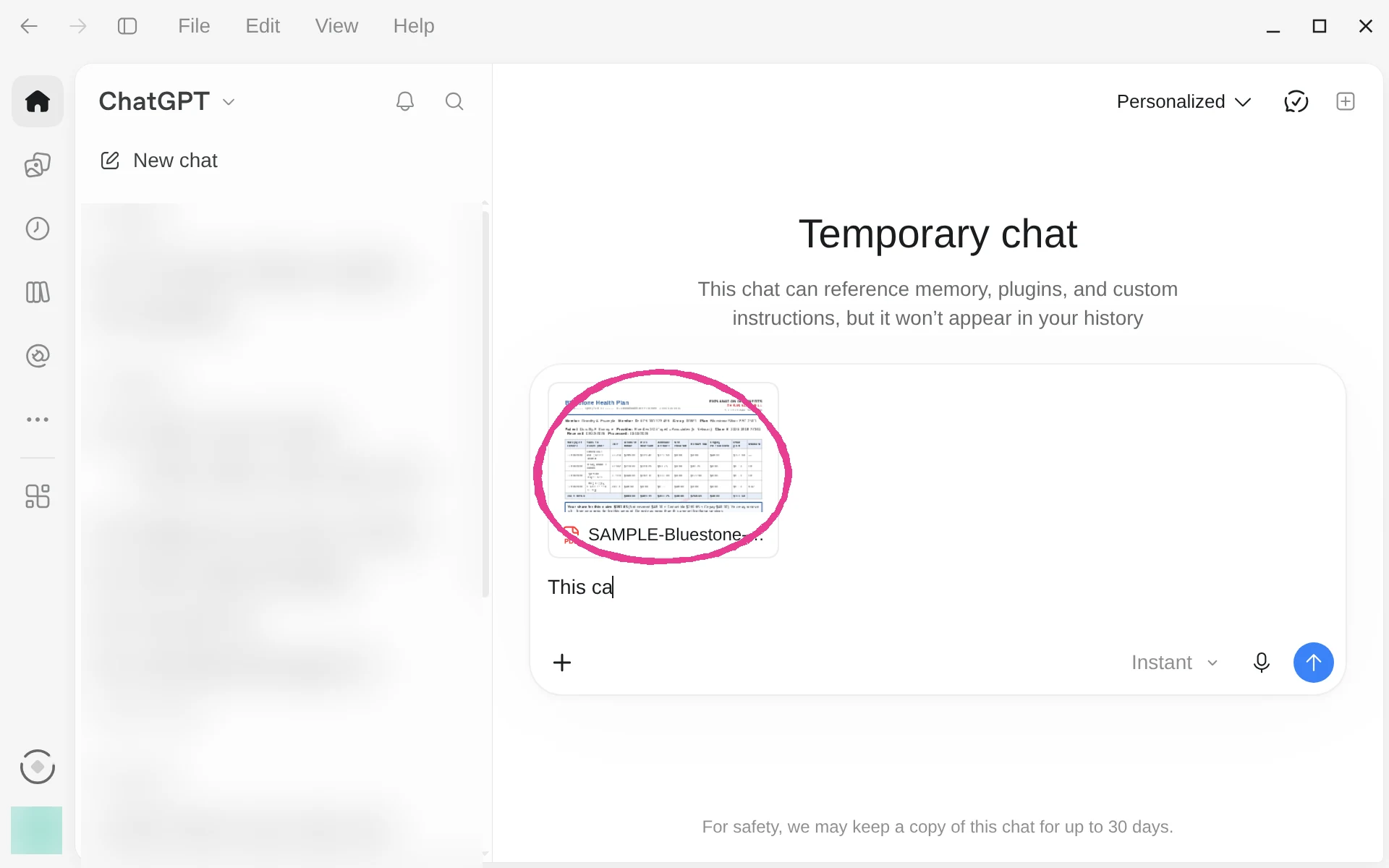
I asked what this statement means and whether I have to pay anything.
2. The insurance statement
An Explanation of Benefits, or EOB, is not a bill. It tells you what the insurance did with a doctor's visit. ChatGPT made a little table.
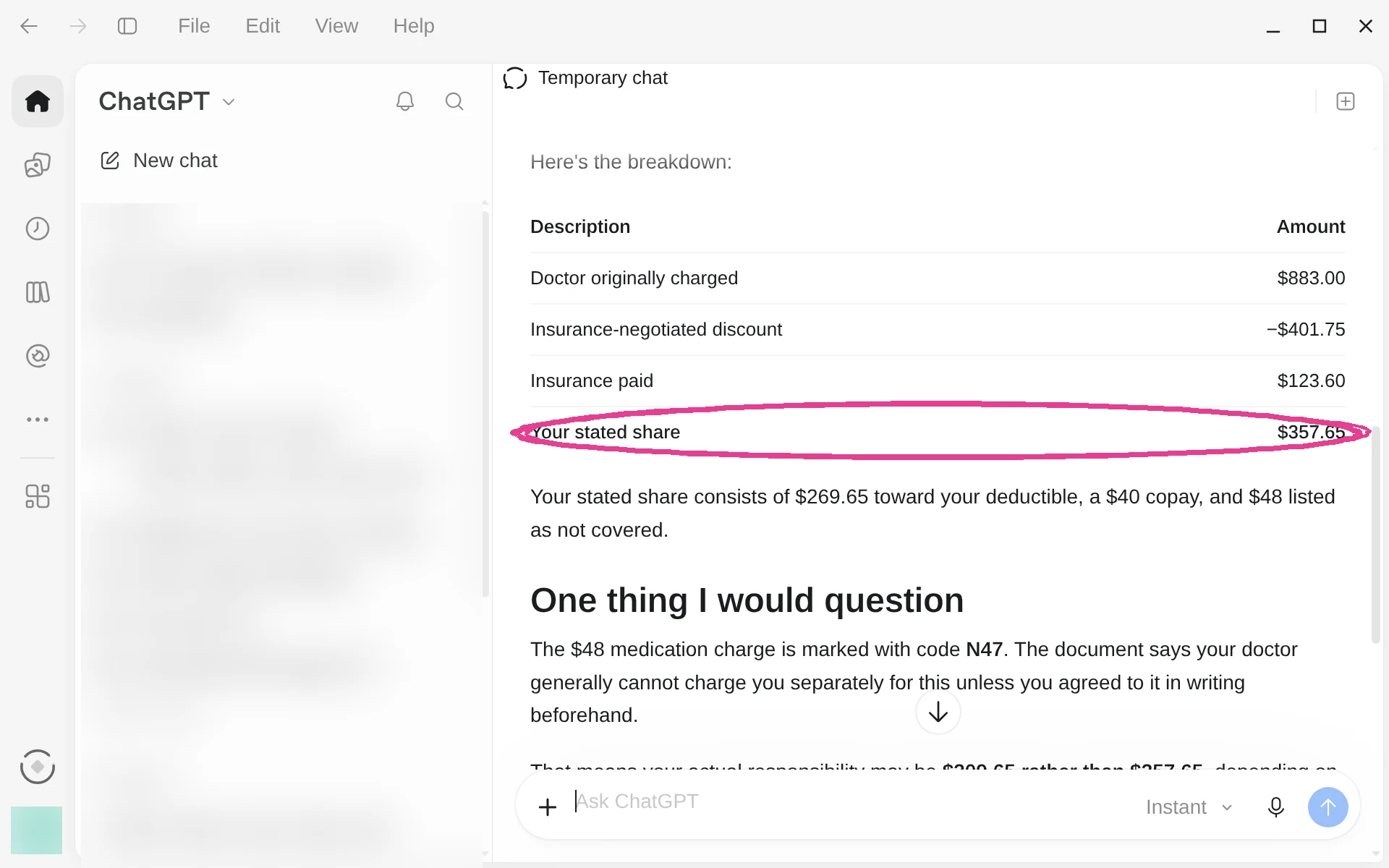
The doctor charged $883.00. The insurance discount took off $401.75. The insurance paid $123.60. My share: $357.65. That's $269.65 toward my deductible, a $40 copay, and $48 for a medicine marked "not covered."
Then it said one thing was worth questioning: that $48 has a code, N47.
3. Check the numbers yourself
Here's where it gets interesting. ChatGPT also said there was "a small arithmetic inconsistency in the claim totals."
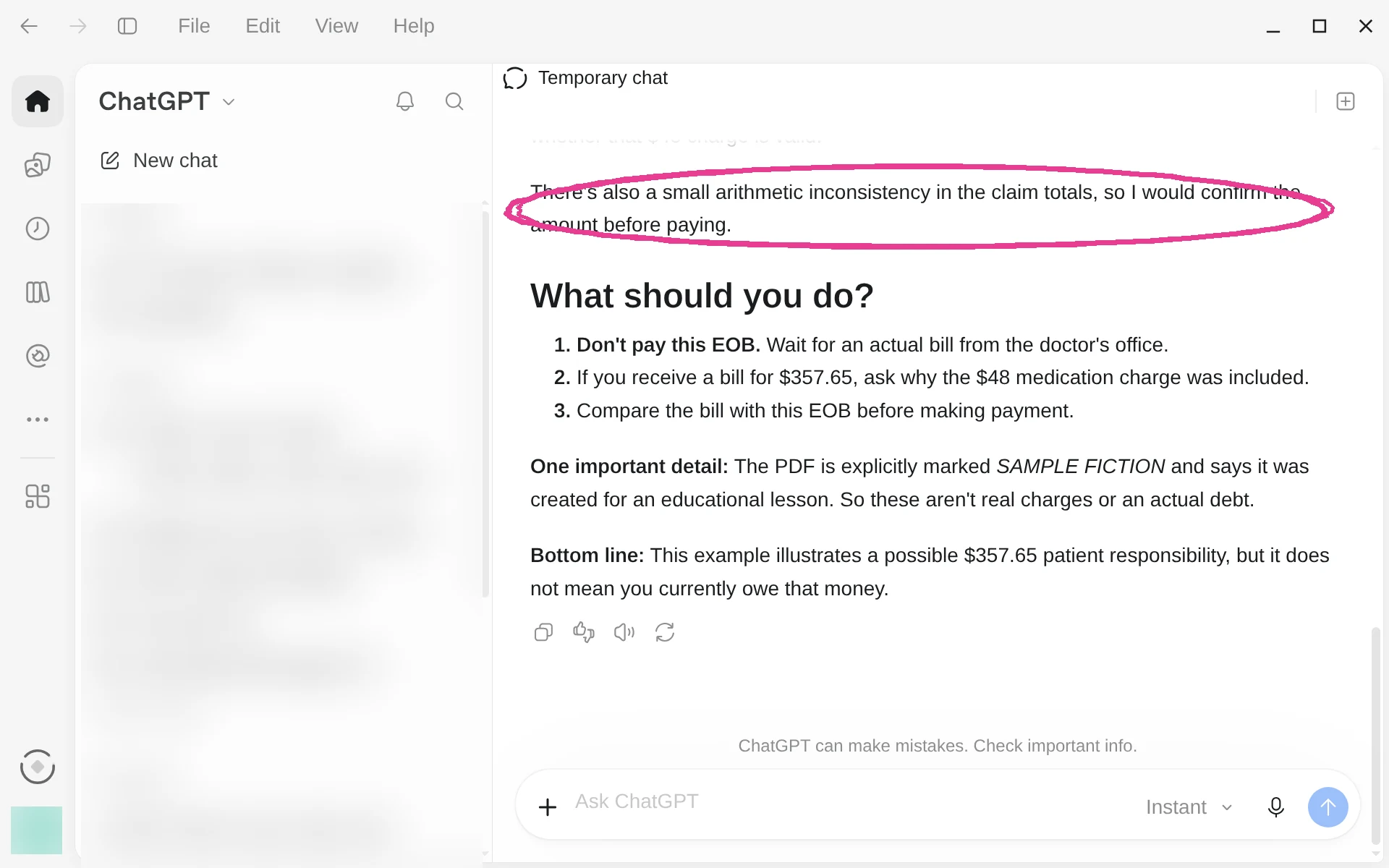
So I checked with a calculator. Every line adds up. So do the totals. ChatGPT was wrong about that.
That's the whole lesson in one moment. ChatGPT is a smart helper that reads fast, but it makes mistakes, even with math. If it says something's off, look at the paper yourself, or ask the company.
Its advice was good, though: don't pay from the EOB. Wait for the real bill from the doctor's office, and compare the two.
4. "How much deductible is left?"
I asked, "What does 'deductible' mean here, and how much of mine is left?"
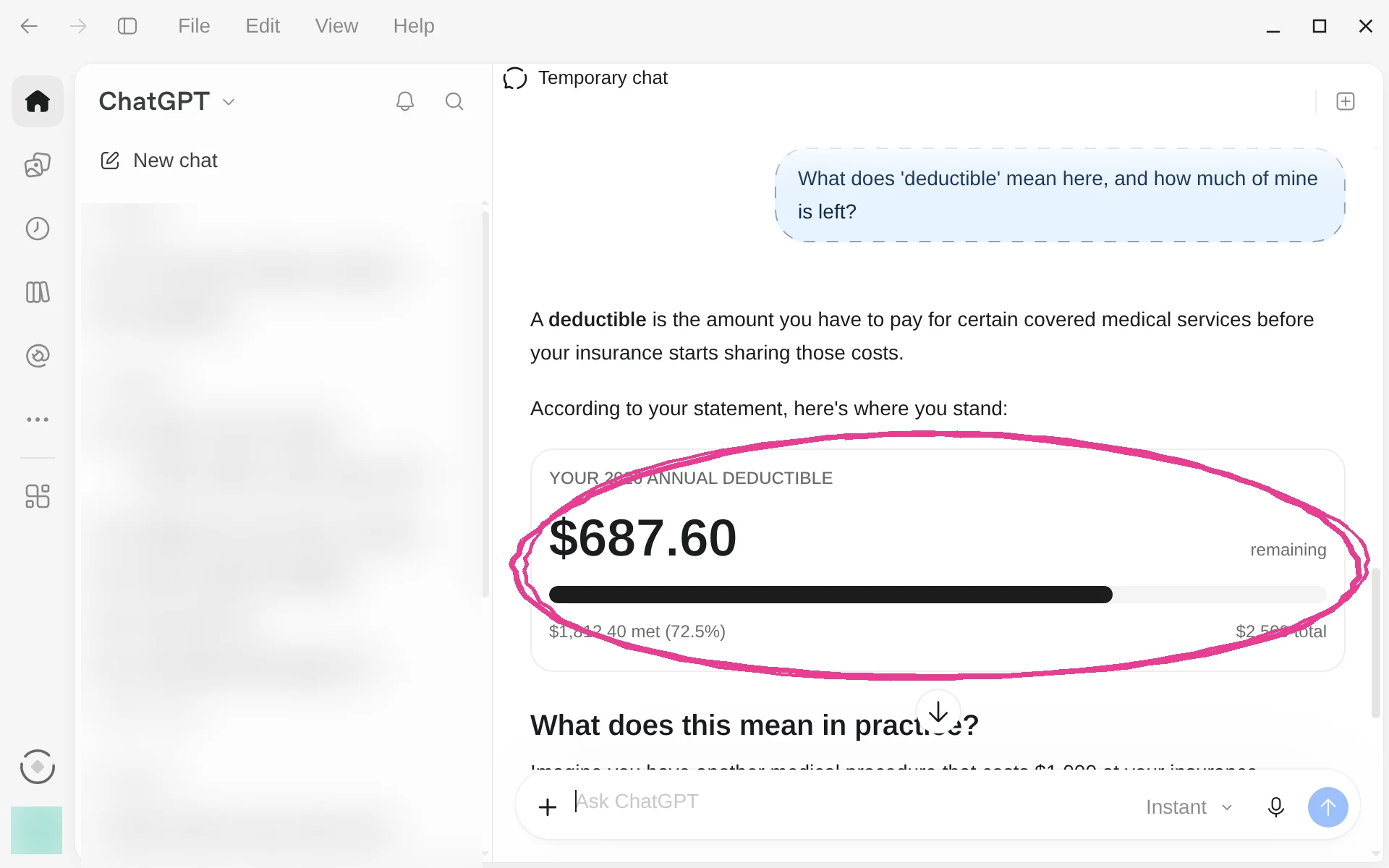
$687.60 left on a $2,500 deductible, with $1,812.40 already met. That matches the paper. Having $687.60 left doesn't mean you owe it today. It's how much more you'd pay for care before your insurance starts sharing more of the cost.
5. The mystery code
I asked what N47 means and what to say if the doctor bills me for the $48.
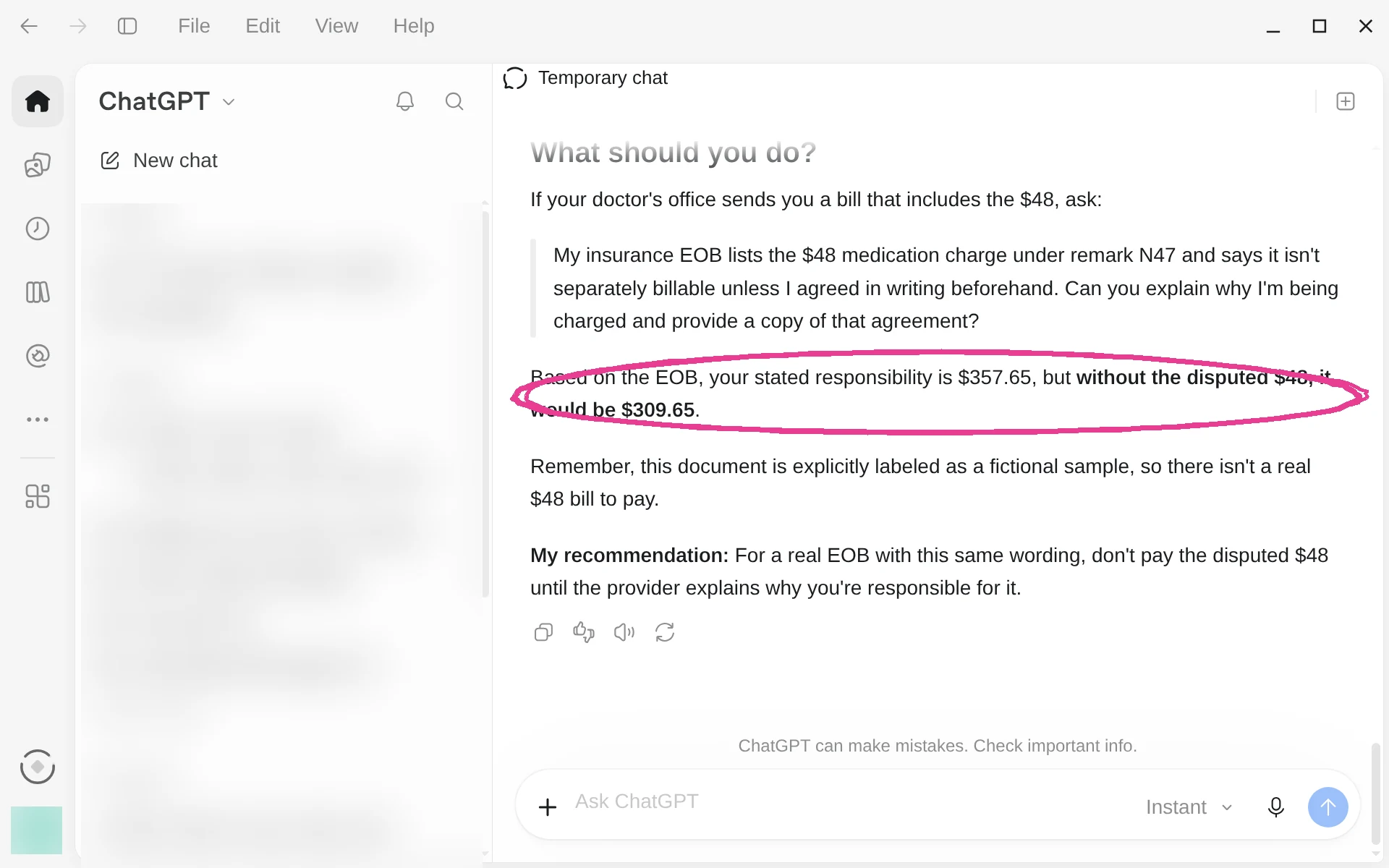
ChatGPT said it would be $309.65 without the $48. That's right: $357.65 minus $48.
The statement itself says the charge "is not separately payable under your plan," and the provider "may not bill member unless member agreed in writing prior to service." ChatGPT put it a bit more simply, but close enough to start a phone call.
6. Questions for the phone call
I asked for the most important questions to ask the insurance company.
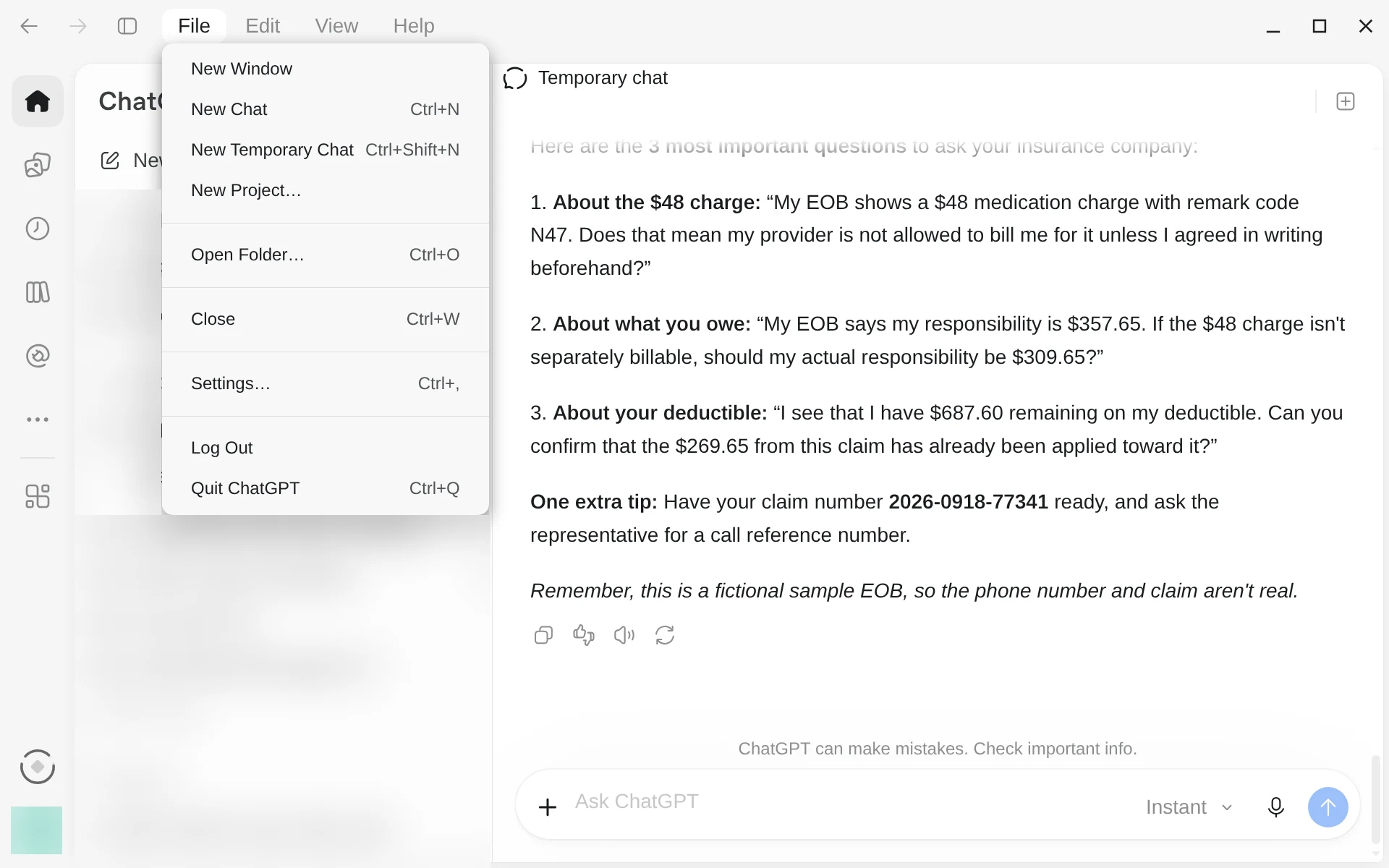
Its extra tip: have the claim number ready and ask for a call reference number. Then call the number printed on your own statement or insurance card.
7. The power company letter
Now the Cedar Valley Power letter. I asked: what's changing, and do I have to do anything?
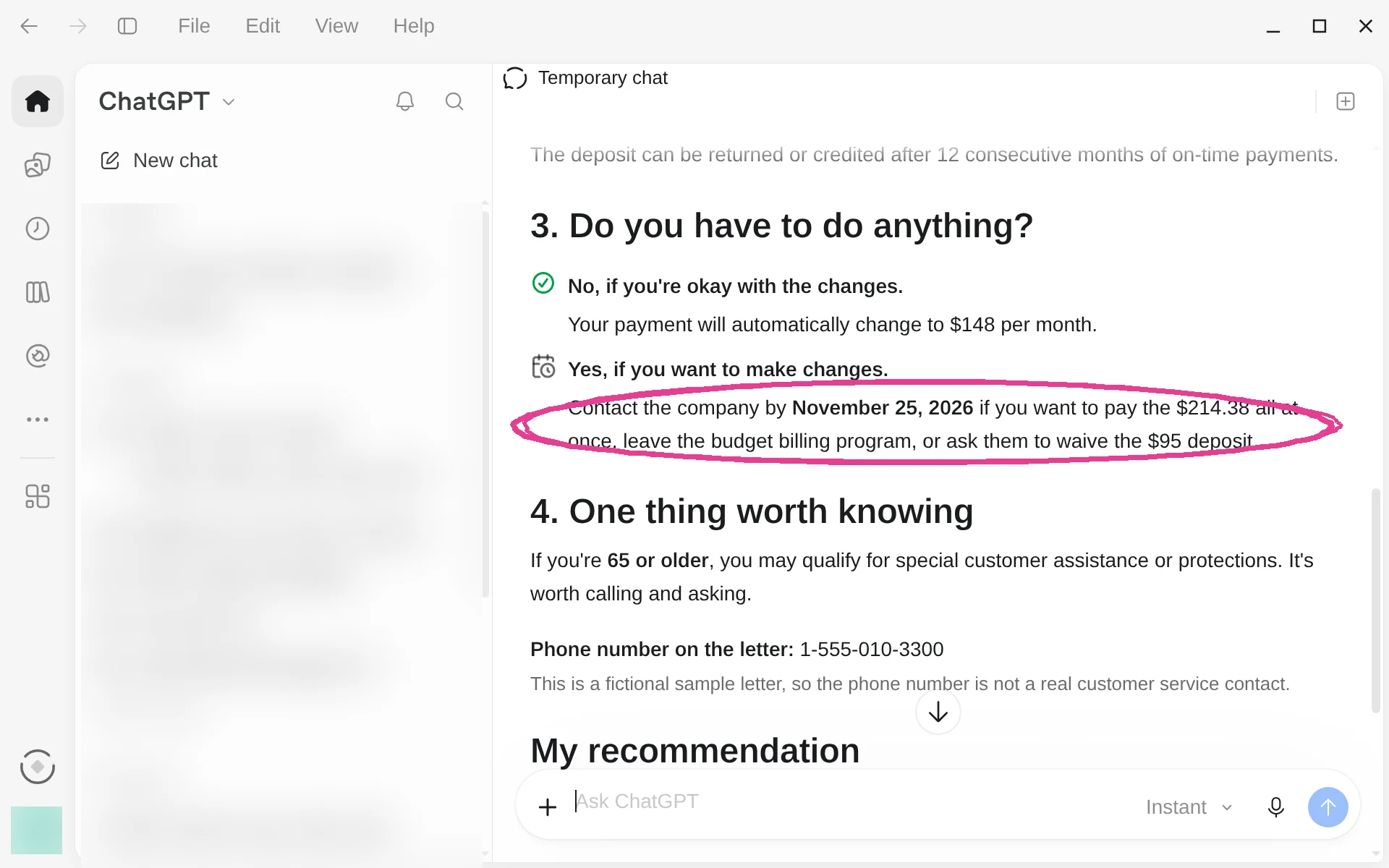
My monthly payment goes from $121 to $148. If that's fine, I don't have to do anything. If I want to pay the $214.38 in one go instead of spread over 12 months, leave budget billing, or ask them to waive a $95 deposit, I have to contact them by November 25, 2026. I checked the letter, and it all matches.
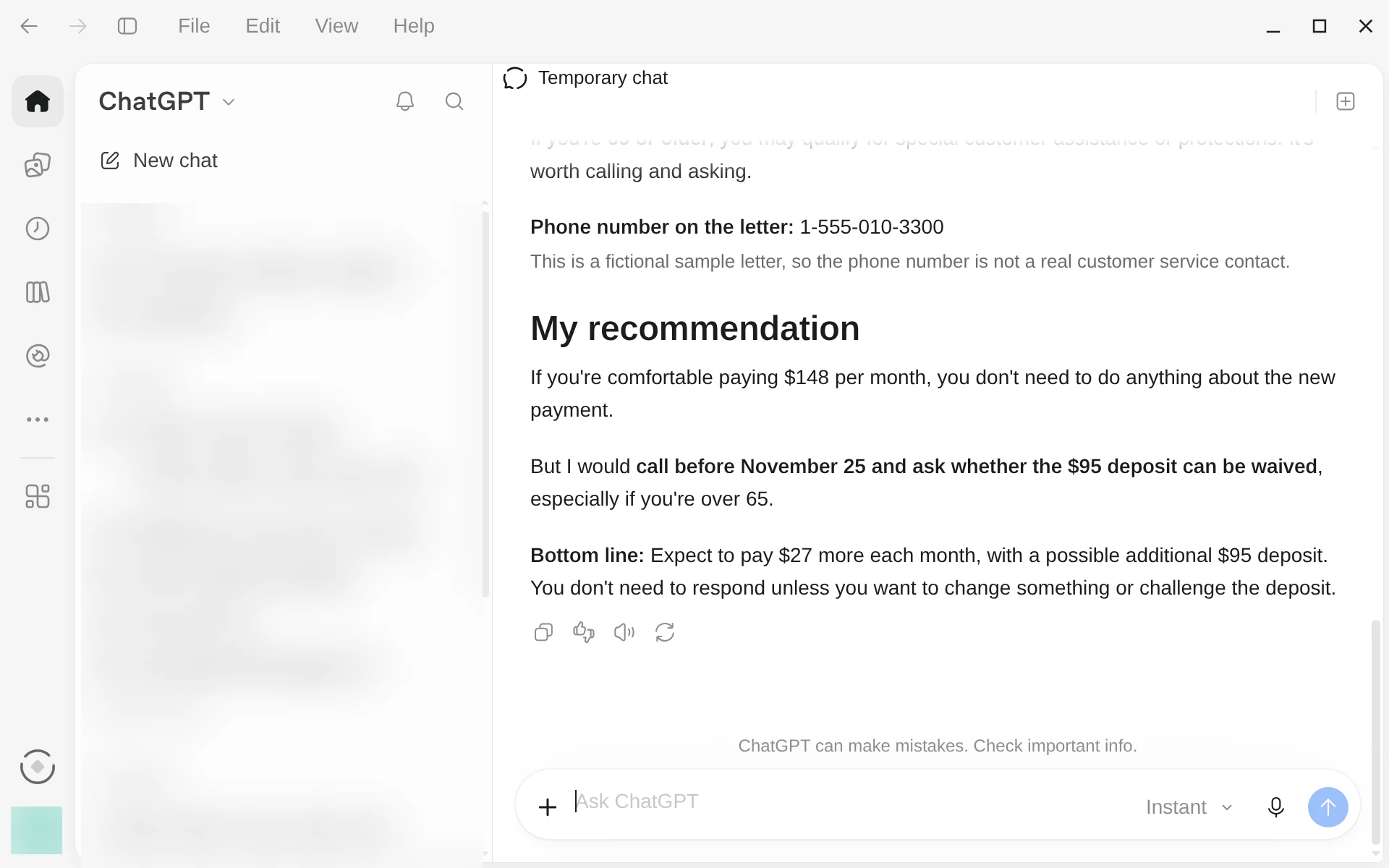
Bottom line: $27 more a month, maybe a $95 deposit.
8. "I'm over 65. Does that help?"
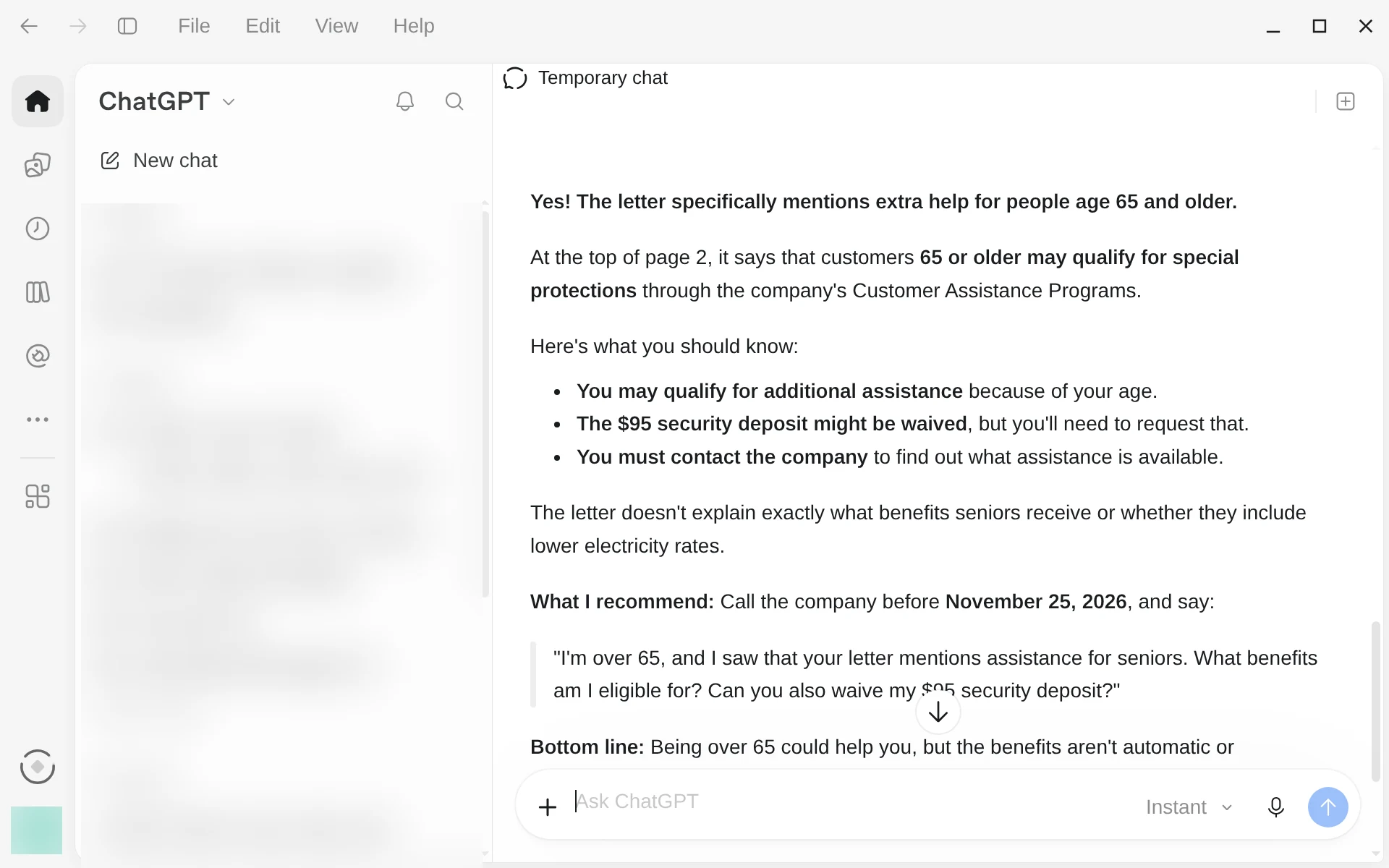
ChatGPT found the line on page 2 and was honest: the letter doesn't say what the help is. So it suggested calling and asking.
9. A page for the fridge
I asked for a one-page large-print summary to print.
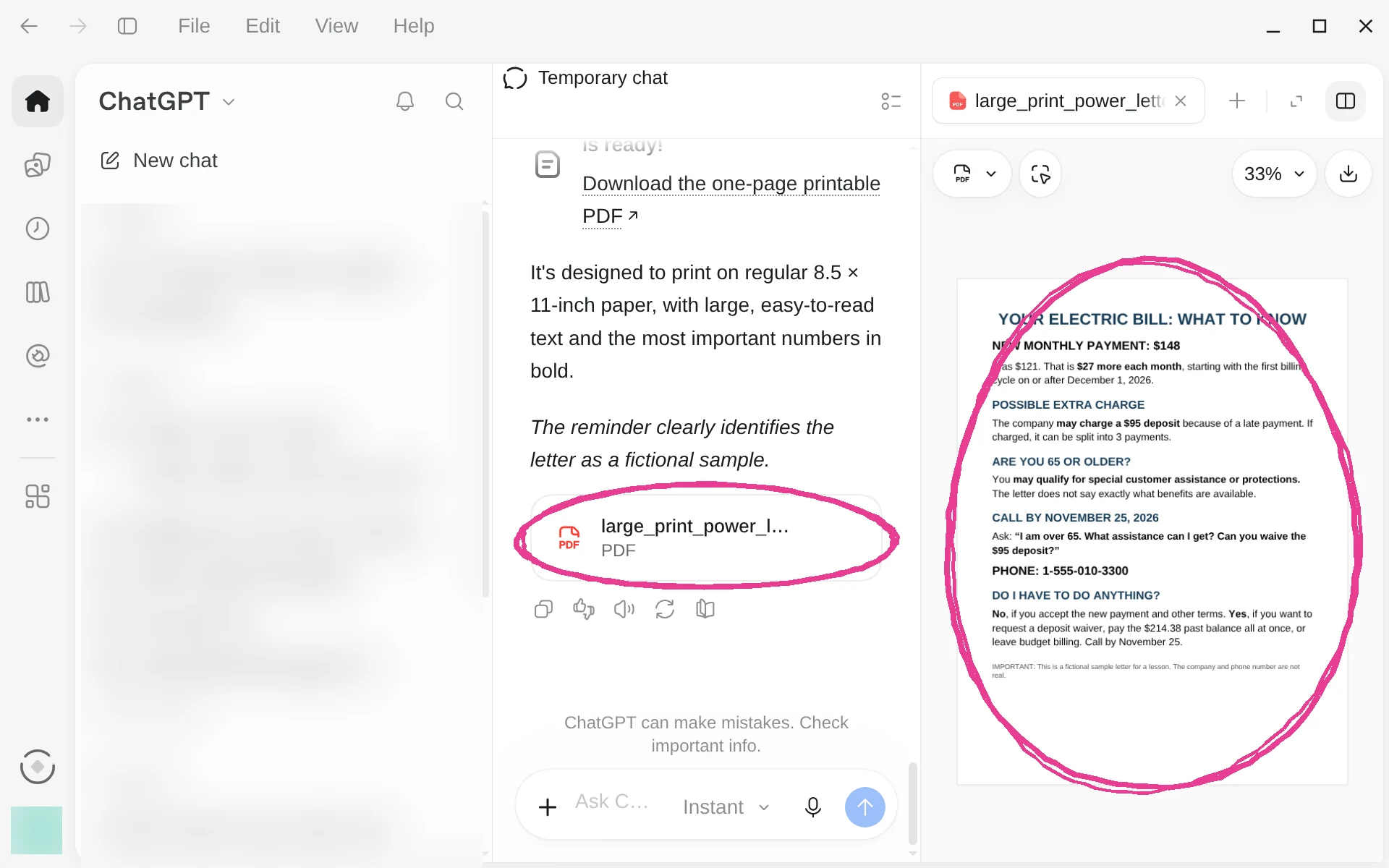
It made one with the new payment, the deposit, the deadline and the phone number. One small thing: it calls the $214.38 a "past balance." The letter says it's the difference between what you paid and what you actually used, which isn't the same as overdue. Fix it with a pen before it goes on the fridge.
Fine and not fine
These are fine:
- Asking "What does this word mean?" or "Do I have to do anything?"
- Asking for words to say on the phone.
These are not fine:
- Uploading anything with your member ID, account number or Social Security number showing.
- Paying, or ignoring a deadline, just because ChatGPT said so.
- Calling a phone number from the chat instead of the one on your own bill.
At the workshop
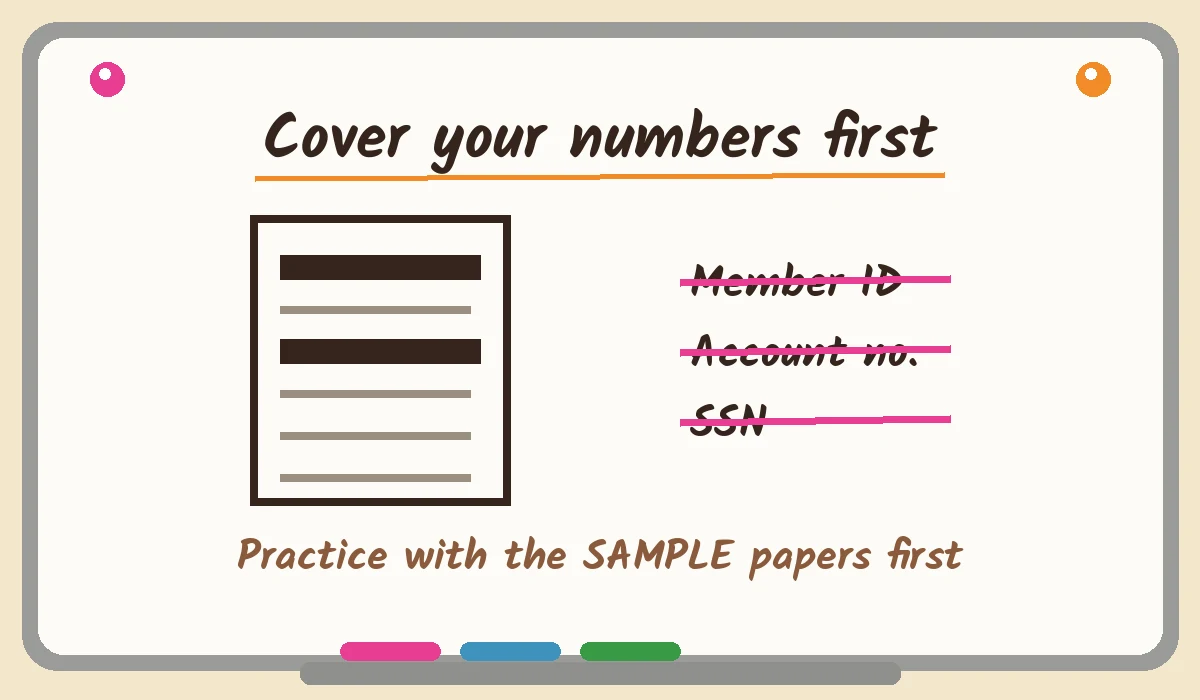
At the workshop: we practice with the SAMPLE papers. If you brought a real letter from home, a helper can sit with you and cover the private numbers first, or you can just type in the one sentence that's confusing you.
Check that you've got it
- You can add a PDF or photo with +.
- You check every dollar figure against the paper.
- You call the number on your own bill.
- You cover private numbers before uploading.
And that's all five lessons. Congratulations! You set up ChatGPT, connected your email and calendar, made a file, spotted scams and read a confusing letter. That's a lot. Come back to any lesson in Everyday ChatGPT, step by step, anytime. They'll be right here.
Let’s learn together.
Comments are reviewed by Ana before they appear. Please use fictional examples and leave workplace details out.
Loading approved comments…