Get examples, analogies and discussion questions from Gemini
Ask Gemini for real-life examples, analogies and discussion questions about a tricky concept, ask for a redo when they're cheesy, and check the facts.
Step 4 of 11 in Choose for the task: lessons, quizzes and slides (Path 03)
Heads up: these screenshots use a personal Google account in Gemini (gemini.google.com) in a web browser on a computer. No subscription.
Coming up with a fresh example at 10 p.m. the night before class is nobody's favorite part of the job. If AI still makes you a bit uneasy, that's fine. Think of it as a tool like Word or Excel that gives you ideas to pick from. You still choose what to use and write it in your own words, so it sounds like you in the room.
This lesson uses Gemini to brainstorm the parts of a lesson that take the longest to come up with: real-life examples, analogies, and good questions for the group. Same ground rule as Lesson 21: nothing private goes in.
Before you start
Heads up: these screenshots use a personal Google account in Gemini (gemini.google.com) in a web browser on a computer. No subscription.
Practice with a concept from your own subject, something your learners often find confusing. I used "pre-tax deduction," which fits with the paycheck lessons (Lessons 23 to 25).
Screenshots are from October 28, 2026, with another notebook's title in the tab row and the chat ID in the address bar blurred. Google moves things around, so yours may not match.
1. Start a new chat
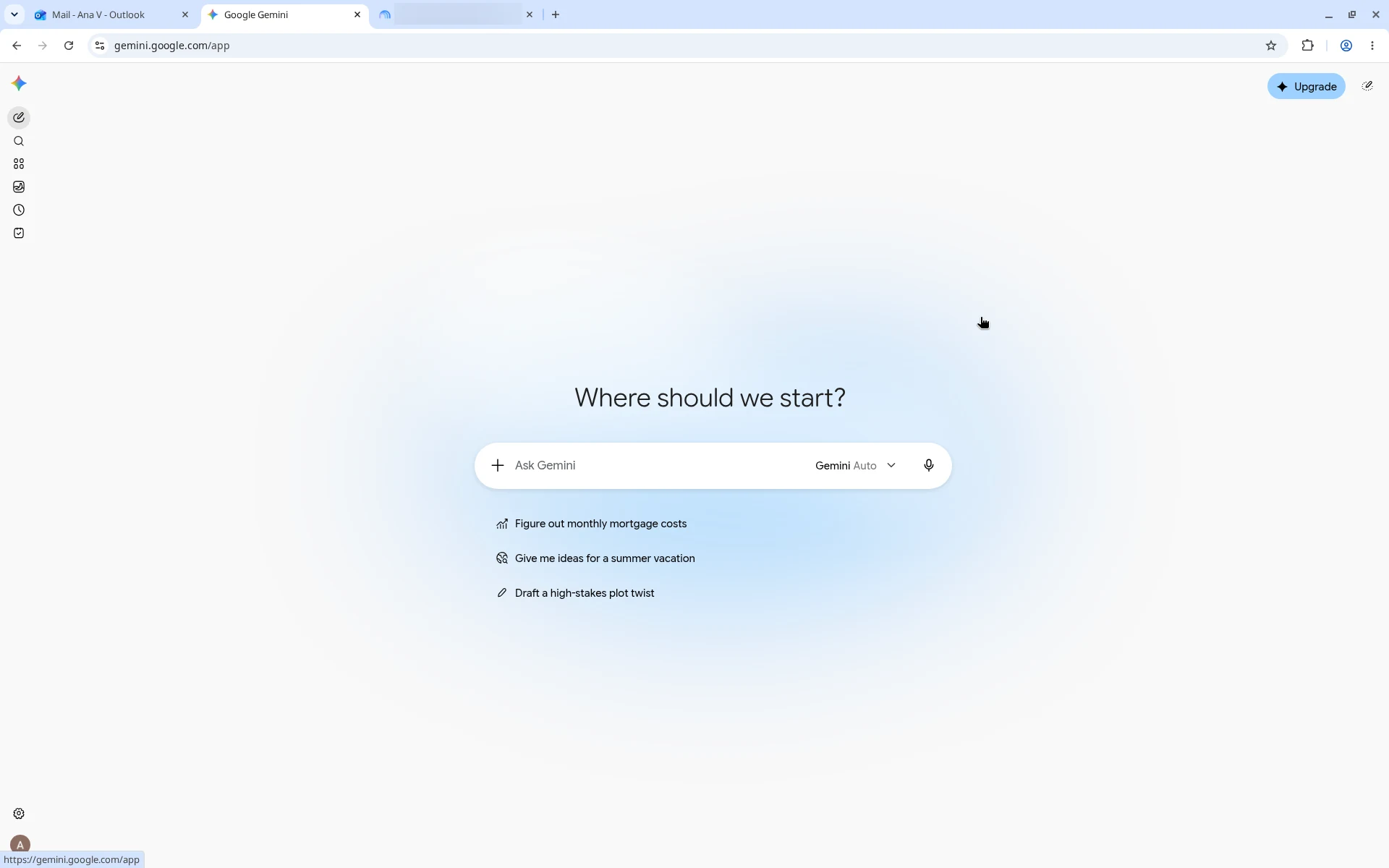
Go to gemini.google.com. If you have an old chat open, click the pencil icon to start a new one. You'll see "Where should we start?" and a box that says Ask Gemini.
2. Ask for examples and analogies
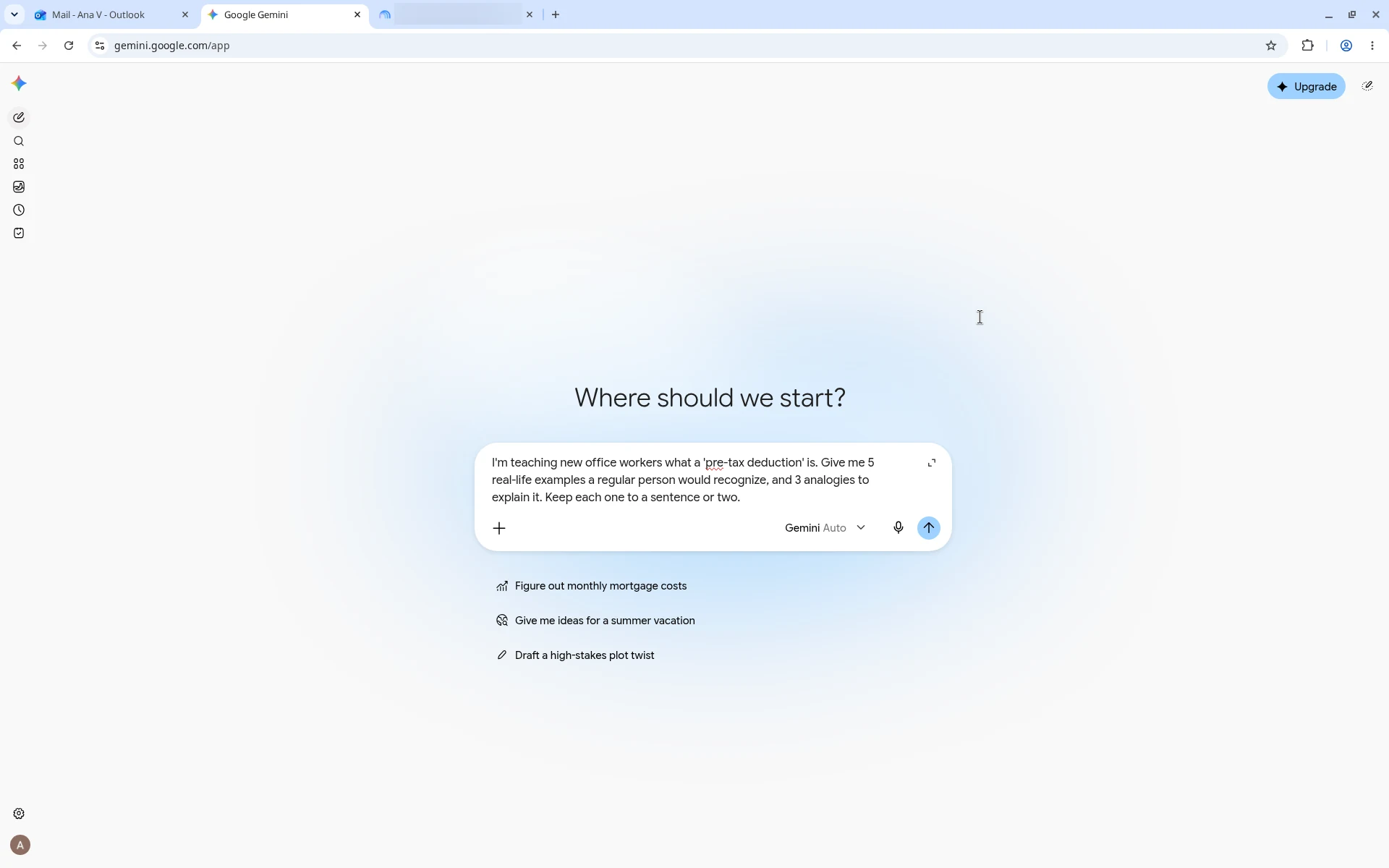
Tell Gemini who you're teaching, what the concept is, and how much you want. I typed, "I'm teaching new office workers what a 'pre-tax deduction' is. Give me 5 real-life examples a regular person would recognize, and 3 analogies to explain it. Keep each one to a sentence or two."
3. Read the examples
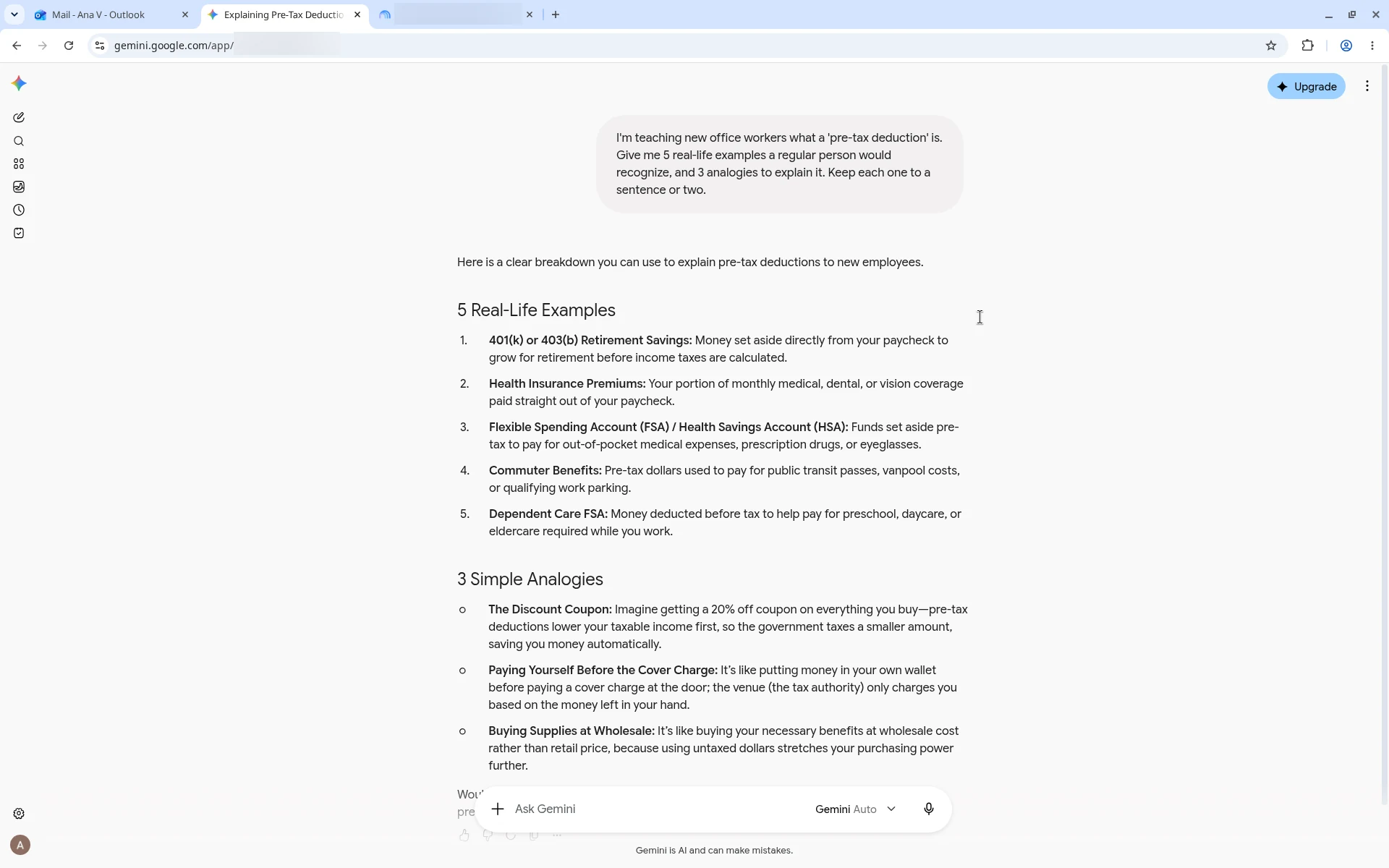
The examples were good. It listed a 401(k) or 403(b), health insurance premiums, a flexible spending account (FSA) or health savings account (HSA), commuter benefits, and a dependent care FSA. New hires will recognize all of these from a benefits form.
4. Read the analogies with a critical eye
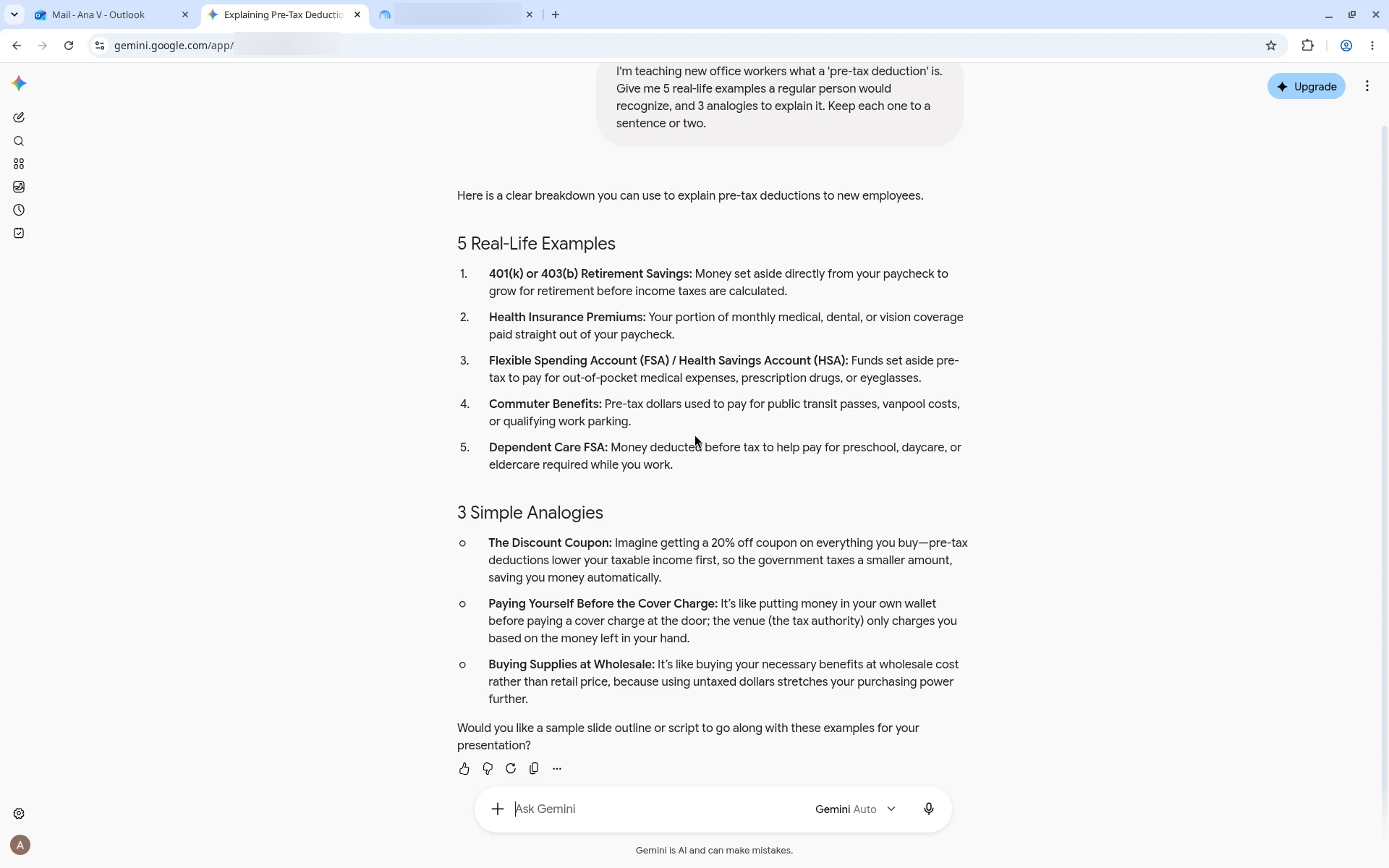
The analogies were another story. "The Discount Coupon," "Paying Yourself Before the Cover Charge" and "Buying Supplies at Wholesale" all sounded more like an ad than something you'd say at work.
5. Ask for a redo
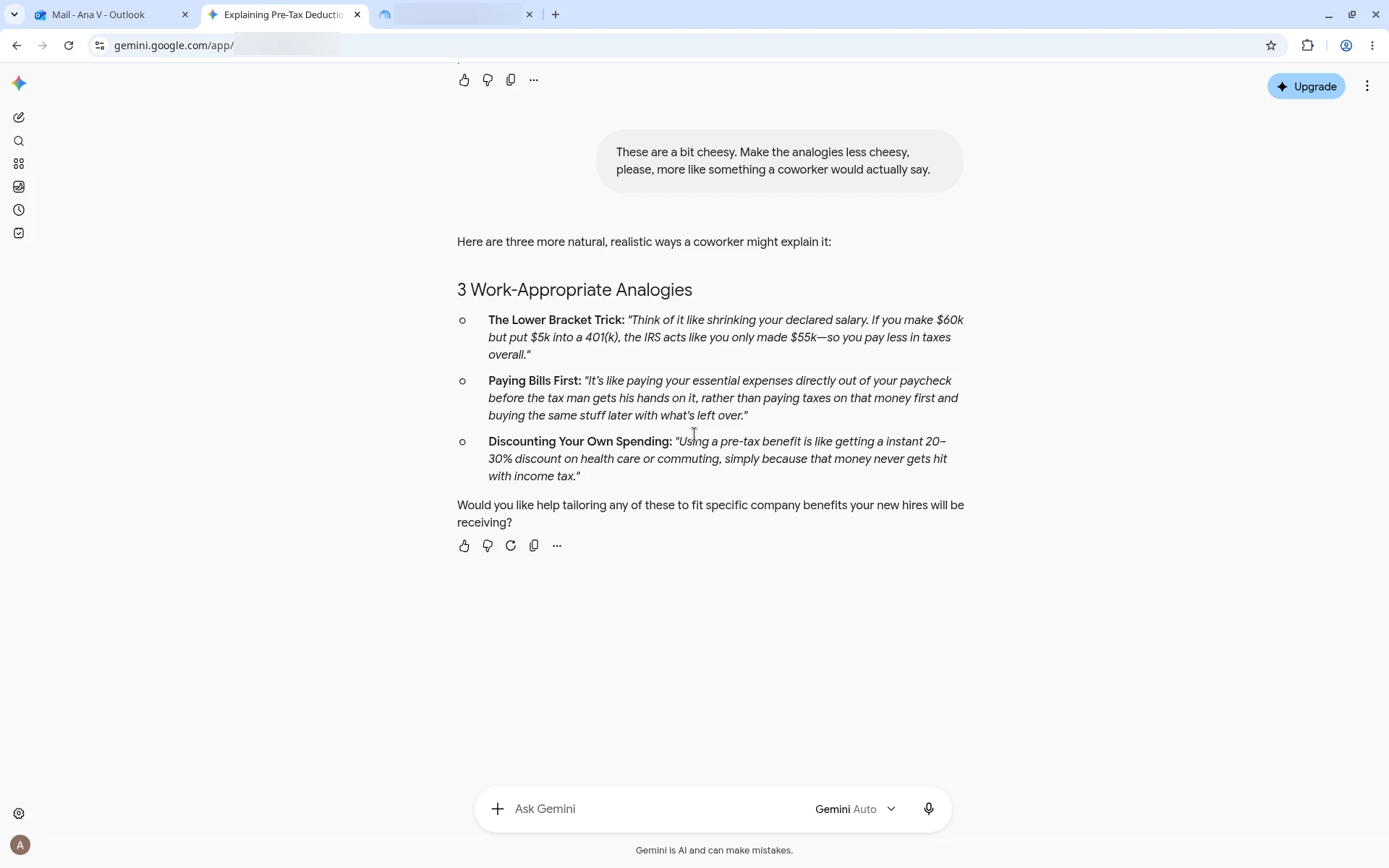
If you don't like an answer, just say so and say what you want instead. That's completely normal, and it's how you get something useful. I wrote, "These are a bit cheesy. Make the analogies less cheesy, please, more like something a coworker would actually say."
This time I got "3 Work-Appropriate Analogies": "The Lower Bracket Trick," "Paying Bills First" and "Discounting Your Own Spending."
6. Pick one and make it short enough to say out loud
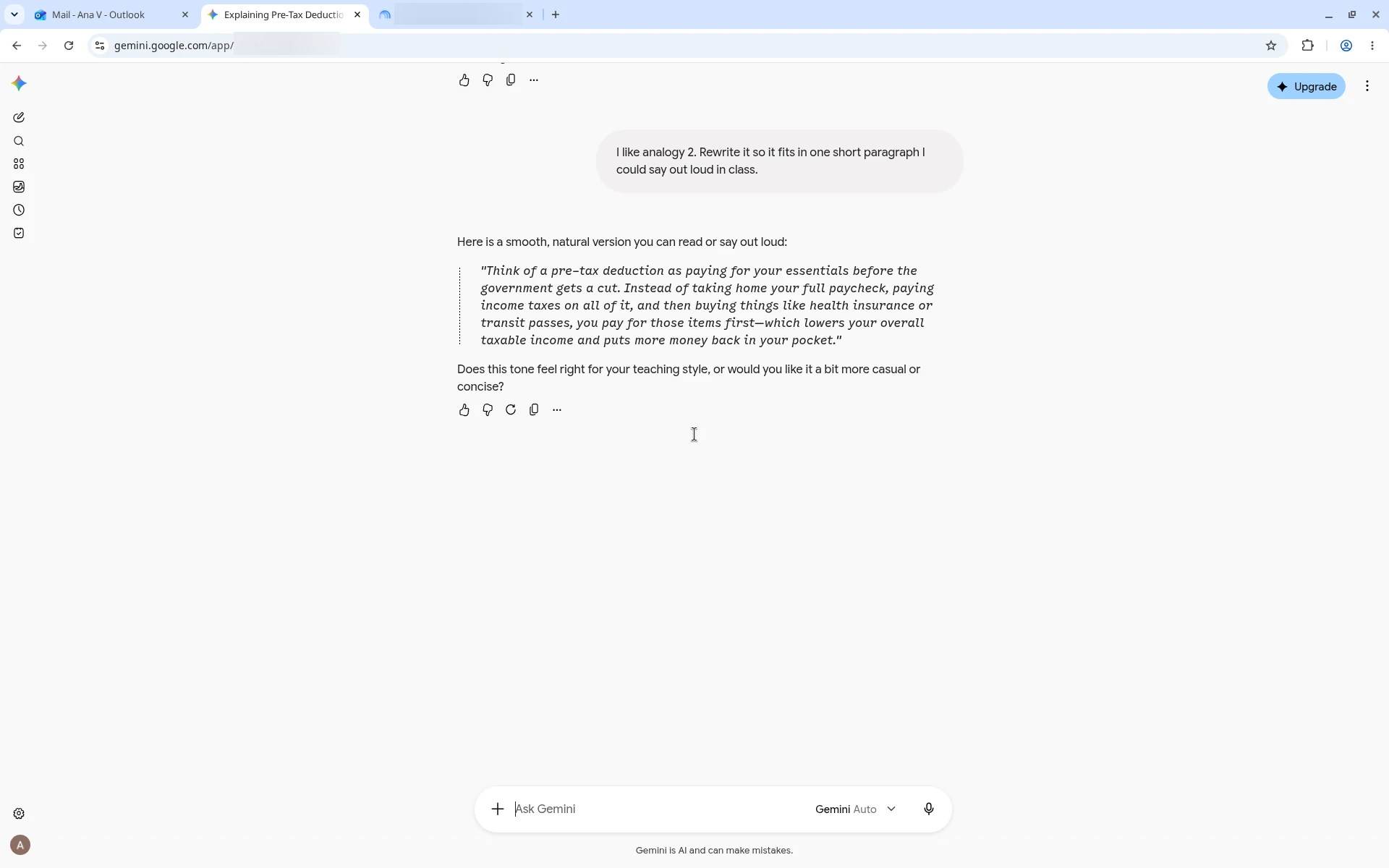
You don't need all three. Pick the one you'd actually say. I liked the second one, so I wrote, "I like analogy 2. Rewrite it so it fits in one short paragraph I could say out loud in class."
Gemini rewrote "Paying Bills First" as one paragraph. It reads well, but it ends with "lowers your overall taxable income and puts more money back in your pocket," and that's where I stopped and checked the facts.
Check the facts before you use any of it
Analogies sound right, so small mistakes are easy to miss. Here's what I found in Gemini's answers:
- "The Lower Bracket Trick" is misleading. A pre-tax deduction lowers your taxable income, but it doesn't necessarily put you in a lower tax bracket.
- The $60k example is fine as math, but it only talks about income tax. Money you put in a 401(k) still has Social Security and Medicare (FICA) taken out, just like we saw on the pay stub in Lessons 23 and 24.
- "An instant 20-30% discount" depends on your tax rate. For some people it's less, so I wouldn't give a number at all.
- "Puts more money back in your pocket" is wrong. Your take-home pay actually goes down, because the money goes to your 401(k), health insurance or other benefit. You just pay less income tax on it.
So here's my version, in my own words, which is the one I'll actually say in class:
"A pre-tax deduction is money for things like your health insurance or your 401(k) that comes out of your paycheck before income tax is figured. So you pay income tax on a smaller amount. Your paycheck still gets smaller, because that money goes to the benefit, but you pay less income tax than if you'd paid for the same thing after tax. For a 401(k), Social Security and Medicare still come out of it."
It's less catchy than Gemini's, but it's true, and nobody will come up to me afterward with a pay stub asking where their extra money went.
7. Ask for discussion questions
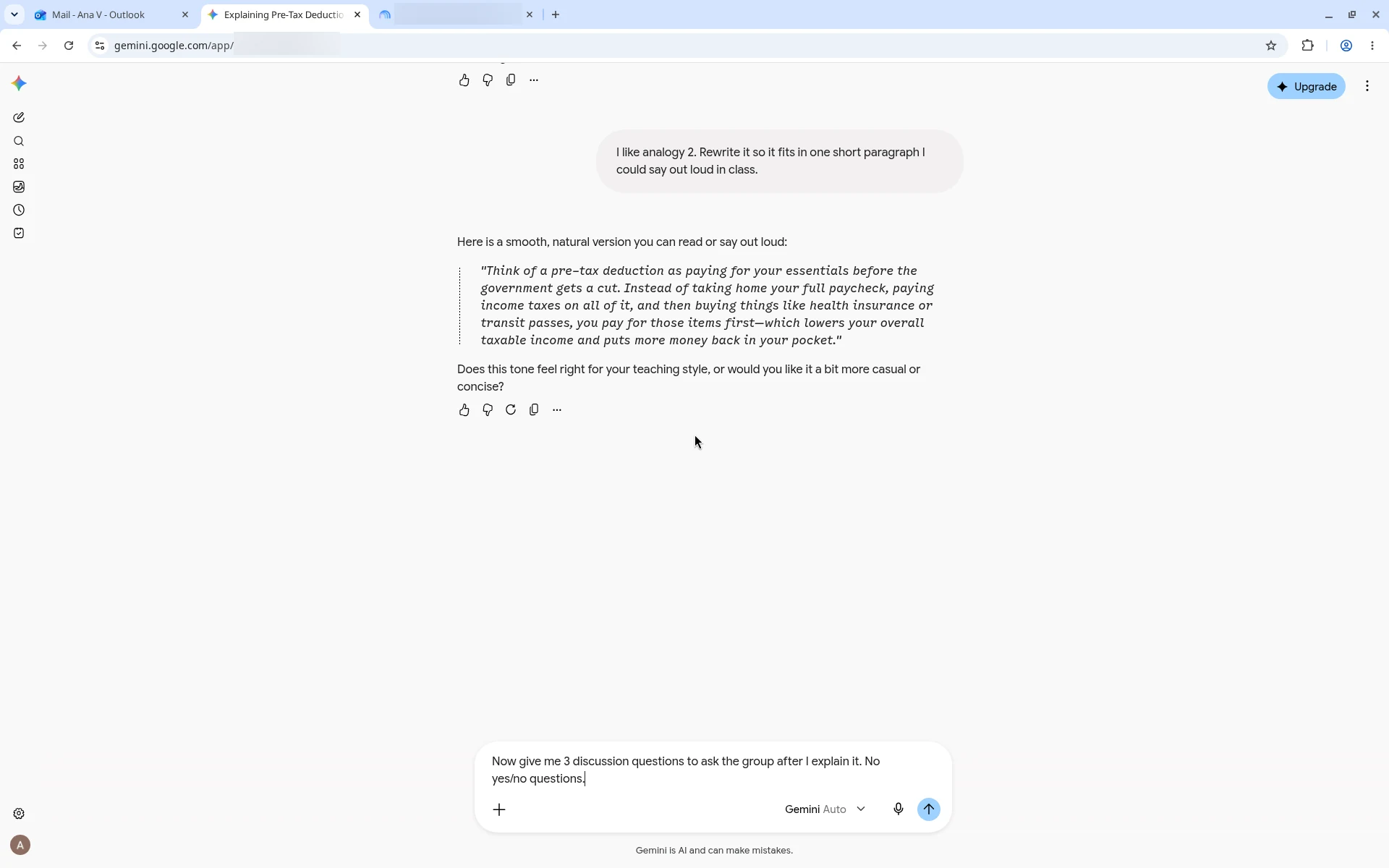
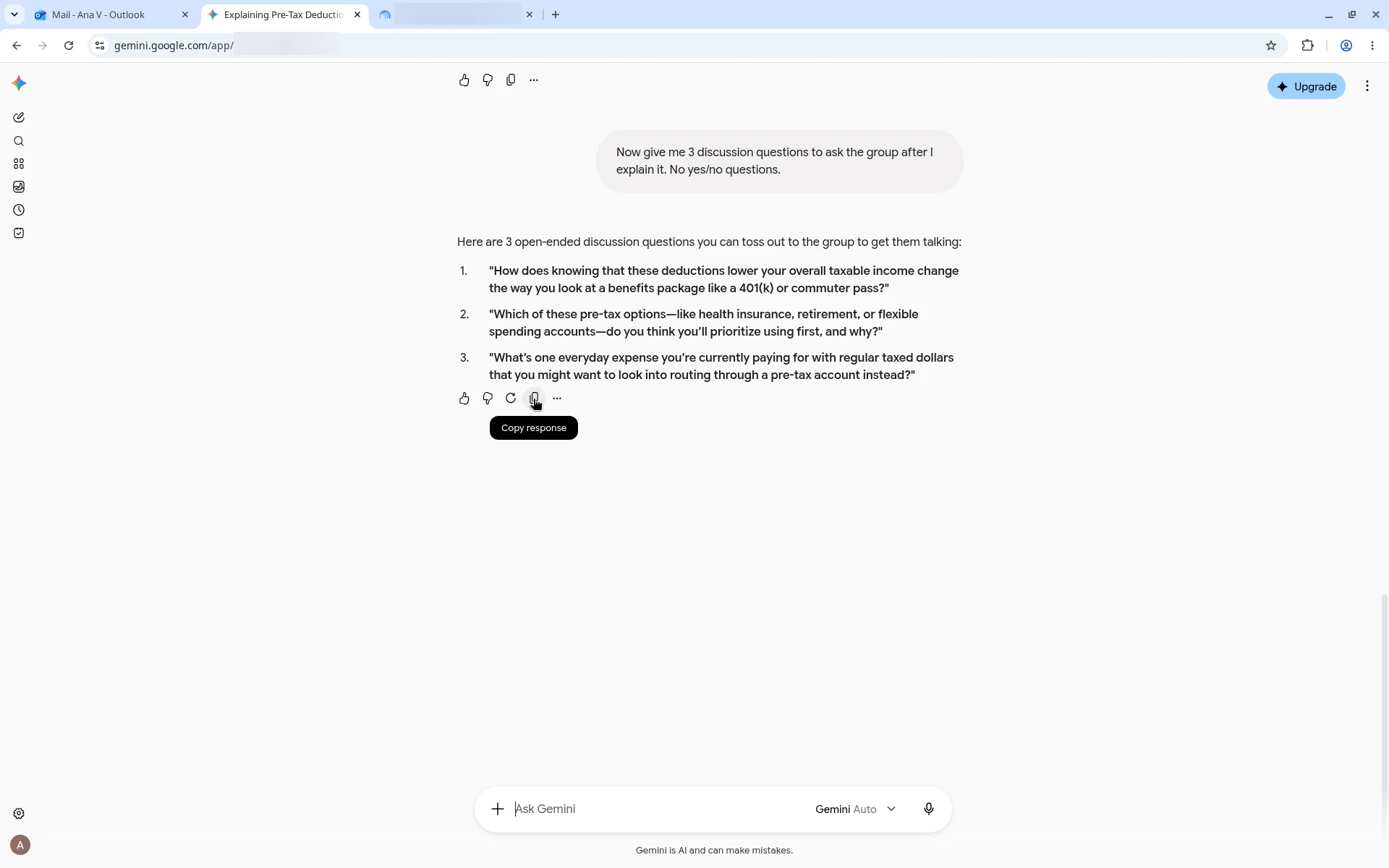
Next I asked for questions to get the group talking: "Now give me 3 discussion questions to ask the group after I explain it. No yes/no questions."
8. Read the questions
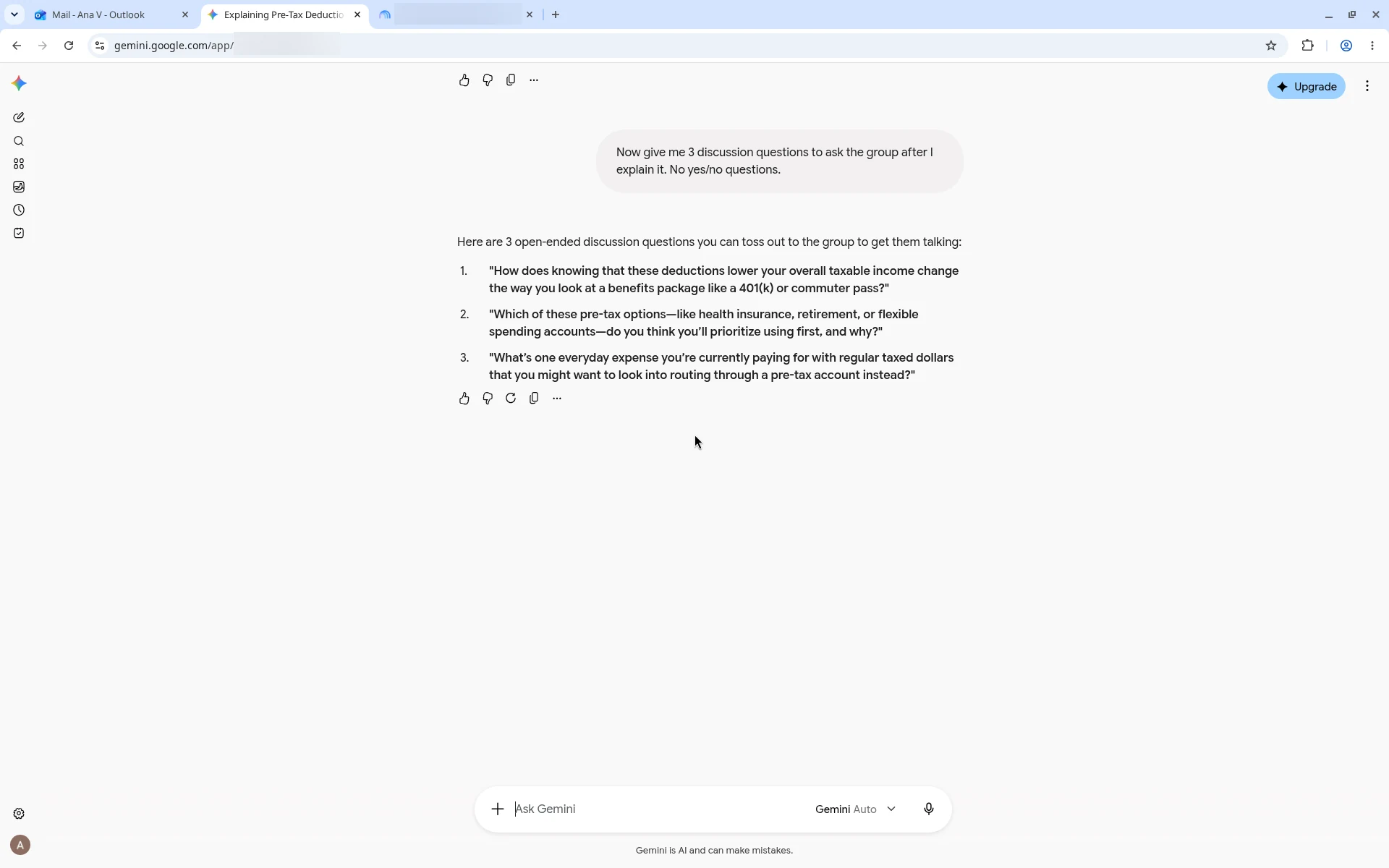
Gemini gave me three open-ended questions. The first one was, "How does knowing that these deductions lower your overall taxable income change the way you look at a benefits package like a 401(k) or commuter pass?" Good discussion questions are like this one. People can't answer them with one word, and there's no single right answer, so everyone has something to say.
If they're too hard or too easy for your group, ask for easier or harder ones.
9. Copy what you want to keep
Under each answer there's a row of small buttons. Point at the copy button and you'll see Copy response. Click it, paste the answer into your lesson notes, and then rewrite it in your own words there.
Fine and not fine
These are fine:
- Asking for examples, analogies and questions about a topic you teach.
- Using Gemini's ideas as a starting point and putting them in your own words.
These are not fine:
- Putting in student names, grades, or anything private about your workplace (see Lesson 21).
- Reading an analogy to your class before you've checked that it's true.
At school or work
At school or work: whether you can use Gemini with your work account depends on your organization's Google Workspace settings. Check with your IT team before you plan a lesson around it.
Check that you've got it
- You asked for examples, analogies and discussion questions about a concept from your own subject.
- You asked for a redo when you didn't like an answer.
- You picked one analogy and checked its facts.
- Your discussion questions are open-ended.
- What you'll say in class is in your own words.
Let’s learn together.
Comments are reviewed by Ana before they appear. Please use fictional examples and leave workplace details out.
Loading approved comments…